How Exposed Is Your CLO Portfolio to France? A Look-Through Analysis
Political uncertainty in France, driven by a contested 2027 budget and the highest government borrowing costs since 2002, keeps making headlines, and investors keep asking the same question: how much of my portfolio is actually exposed to France?
For anyone doing CLO portfolio analysis, the answer isn't a single number you can pull from a report. The exposure you care about doesn't sit at the CLO level. It sits in the underlying loans.
And for European CLO investors, there is plenty of it to find. According to S&P Global Ratings, French borrowers made up 18.39% of collateral balances in the agency's 2025 European CLO sample, the largest country exposure in the study. If you hold European CLOs, French borrowers in leveraged loans are almost certainly in your portfolio. The question is how much, and where.
Why Country Exposure Is Hard to See in a CLO Portfolio
A CLO is a pool of hundreds of loans. A portfolio of CLOs is a pool of those pools, and the same borrower can appear in several of them. To know your French exposure, you have to look through each holding to its loans, identify which borrowers are tied to France, and then roll the results up across everything you own.
Even "tied to France" takes a judgment call. A borrower can be domiciled in France and earn most of its revenue abroad. Another can be headquartered elsewhere and depend heavily on French operations. Domicile, revenue, and operating footprint each tell a different story about country risk. Pick the one that matches the risk you are measuring, and apply it the same way across every holding.
Then there is weighting. A borrower can be a big piece of one CLO and a small piece of your total holdings. What matters is its share of everything you own, not its share of any single deal.
Done by hand, all of this usually means pulling holdings from one system and loan-level data from another, mapping borrowers to countries, and rebuilding the roll-up in a spreadsheet. It is slow. It is also easy to get wrong, and it is out of date the moment your portfolio changes.
Finding the Exposure That Actually Matters
If the exposure lives in the loans, that is where you need to look. That takes two things: a method for seeing through every CLO to its collateral, and tools that make the method practical across your whole portfolio.
What CLO Look-Through Analysis Changes
CLO look-through analysis answers the question at the level where the risk actually lives. Instead of asking how a CLO is rated or how it is performing in aggregate, you work from loan-level data and ask what the underlying loans are, where they sit, and how concentrated you are across all of them at once.
For a question like French exposure, that means you can see:
- How much of your total holdings is tied to French borrowers, across every CLO you hold
- Where your CLO country exposure is concentrated, and in which positions
- How your CLO concentration risk to France compares with your other country and sector exposures
Finding the exposure is the first step. Knowing what it could mean is the second. France's sovereign troubles do not automatically turn into corporate loan losses. But tighter financing or a weaker economy could squeeze some leveraged borrowers, and that can show up as falling loan prices, downgrades, or defaults.
CLOs are not forced to sell when a loan is downgraded or drops in price, so the pain tends to surface inside the deal instead: in CCC buckets, coverage tests, and projected cash flows. Knowing exactly which positions hold those borrowers tells you where to look first.
How Valitana's CLO Analytics Helps
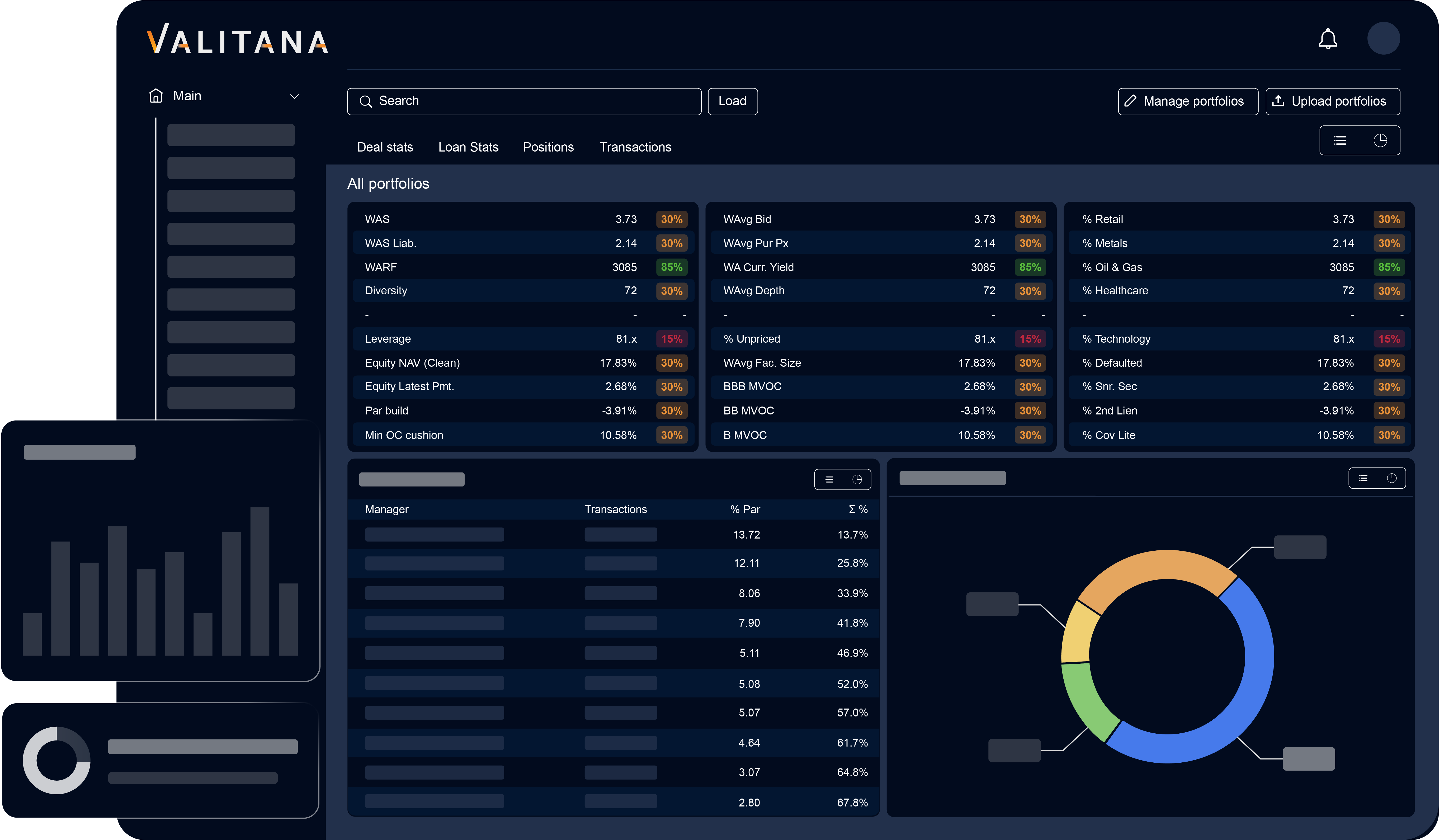
Custom Analytics in Valitana Analytics lets you build analysis directly against your current portfolio. Valitana looks through your CLO holdings to the underlying loan-level data, picks out borrowers that appear in more than one deal, and shows how concentrated French exposure is across your entire holdings.
Because the analysis runs on your actual portfolio, the result is specific to you, not a market-wide generalization. Custom metrics and calculations let you define exposure the way your team does. And because Valitana does the look-through and the roll-up, you are not rebuilding the analysis by hand every time something changes.
Valitana's CLO analytics also connect what you find with what it could mean. With direct Intex integration, you can adjust default, recovery, prepayment, and spread assumptions and see what happens to projected cash flows, valuations, and coverage tests.
It Is Not Just About France
France is the question in the headlines today, but the method works for whatever comes next: another country, a sector, a single borrower that shows up in more places than you expected. A look-through view you can build quickly turns a headline into a portfolio question you can answer the same day.
If your CLOs sit alongside other funds and asset classes, Valitana's alternative investment software brings them into one view, so you can track risk, performance, and compliance across everything you manage.
If you hold CLOs and want to see your CLO concentration risk to France, or to any other country, sector, or borrower you are watching, Valitana can walk you through Custom Analytics.
Get started with Valitana
Schedule a demo to see how Valitana can help your team. Or contact us by email at sales@valitana.com.